TORONTO — Just four games into the Toronto Maple Leafs' season, it can be tough to parse randomness from truth. The team is running out a group that’s seen as much turnover as any in the NHL, pre-season has been cut down to about three hard laps and a pull-up (which they’re not allowed to measure), and you don’t even know the strength of the opponents you’re facing.
But, hey, look: that’s not gonna stop me from trying.
With a record of 2-2-0, we’ve seen enough of the Leafs to say there’s been a number of positive signs and a few flashing alarms. Let’s get into those with three up and three down.
UP
Auston Matthews: One thing nobody disagreed about heading into this season was the sentiment, “If the Leafs are going to get back to being a playoff team, Auston Matthews needs to be closer to peak Matthews than the guy we saw under Craig Berube.”
Through four games, and with his most recent showing against Nashville as our backdrop here, he looks like the forceful version of himself yet again. While the points didn’t come in the first few games, he was part of a line that controlled the play, they held on to pucks in the O-zone and created opportunities at the net. The numbers for his line with Kirill Marchenko and Jack Roslovic have been superb, ranking third (according to MoneyPuck) in expected goals percentage among groups who’ve spent at least 20 minutes together:
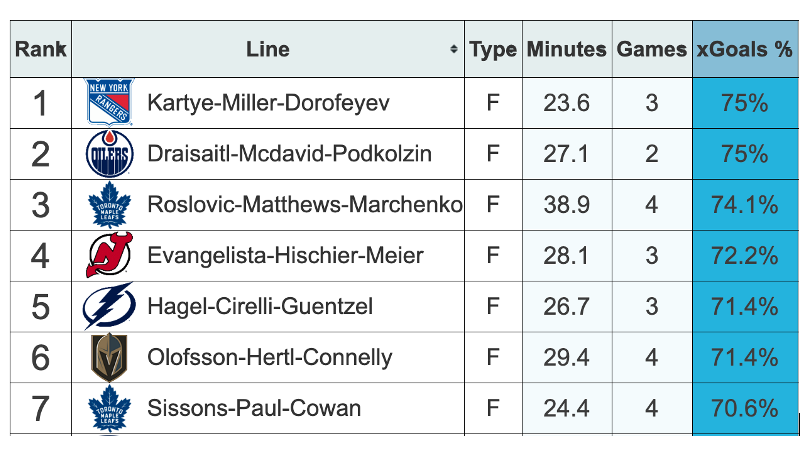
For Leafs fans, I cut it off at seven so you could see another bright spot there, which leads me to the next point.
Overall forward skill: Through four games, Jack Roslovic has three points and 10 shots, and clearly has the speed and skill to play with good players. It’s not that I think he’s some significant needle-mover in the long run — he makes some hope passes I don’t love, and historically slows down as the games get harder — but he’s a clear upgrade on the players they’ve typically had outside the big names.
More than that, though, we saw what Gavin McKenna is capable of against Nashville, and it’s not just the points. He was making more small, skilled plays that keep the puck moving somewhere dangerous for the Leafs, and they missed guys with his kind of vision last year. He’s just another guy who can create something from nothing.
Then there’s that Easton Cowan-Nick Paul-Colton Sissons group above, who’ve been incredibly effective at forechecking and winning pucks back, to say nothing of their ability to create once they’ve got it. Both Cowan and Paul could comfortably slot in higher in the lineup when the need arises, and for some years the Leafs have been light on guys outside the top few who could really make something happen.
Darren Raddysh’s fit: Raddysh’s first game as a Leaf was an abject mess, as he absolutely could not make a breakout pass. By his own admission, he had nerves being with the Leafs, a team he grew up watching with his dad, whom he lost earlier this year. He was feeling some pressure.
But as the games have gone on, it’s clear that he’s the fit they hoped he’d be. He’s got 11 shots in four games and leads the NHL in “shots between 90-100 m.p.h.,” with six (the next highest is three).
He’s also just got a better sense of distributing on the power play, he’s steady in overtime and, overall, they’re just really relying on him. He leads the Leafs in TOI per game at 23:15 (to good results), which is over three minutes more than their next most-used D-man (Morgan Rielly). They’d be in big trouble without him back there.
DOWN
Aging D-corps looks … aged: The Leafs are lucky to have Chris Tanev back, a guy who was arguably their best D-man in his first year with the team. They need his leadership. After a missing most of last year and not getting any younger, he still looks … mostly good. Granted, it seems like he’s still rediscovering his stride, and some of his reliable breakout passes haven’t been as solid as usual, and it’s possible he won’t quite live up to that first-year standard.
Past Tanev, though, you’ve got Oliver Ekman-Larsson not being quite as effective as he’s looked in the past (he’s sixth of six in TOI among Leafs D) and Jake McCabe not being super visible, and suddenly a D-corps that went into the year seeming “mostly steady” has looked shakier than they’d like.
The team, to me, has the feel of a group with firepower and forechecking up front, the type that could win a lot of games when they get to the right half of the rink. But it’s hinging on the back end holding up, and I’m concerned about how it’s going to go as the season gets on and injuries show up. They need another D who can handle real minutes along with Raddysh. Troy Stetcher — who is fine, serviceable — is playing almost 18 minutes a night, which isn’t a great sign about the effectiveness of the rest of the group.
The spot at 2C: John Tavares is a lot of good things. He’s on a cheap contract and fresh off a game where he scored them a huge goal that started their rally back from down 3-0 in the season’s first “must win” (of many, I’m sure). He’s a hard worker and great finisher and all those nice things. But he’s also older, and was never fast, and has struggled to stay effective amidst the pace of today’s game at five-on-five. Last year, he struggled there too, and so as much as the Leafs don’t want to insult the guy, they have to be realistic about how he can best help them.
McKenna would do well to play with Paul, who’s still effective at winning pucks and tilting the ice in his team’s favour. He can get a line in the O-zone, and flipping him and JT probably gets William Nylander and McKenna on offence more, where Paul can get to the net and finish what chances they create at the net.
If you want to take it further, you could have Sissons move to centre and have Tavares play wing with him and Cowan, just as one random example. The point is, as long as the Leafs have Tavares at 2C, they’re going to lose the expected goals (and, in turn, real goals) battle. It’s a spot of weakness, and one they don’t have to sit idly by and watch when they have options. Let Tavares eat on the power play, and get some softer matchups (and skate less) at five-on-five.
The schedule: It would’ve been nice for the Leafs to go on the road while they sort things out in the early going, get to know each other better in the hotels and at team meals, and not deal with the expectations out of the gate.
Instead, McKenna immediately felt the weight of the daily media, they lost a couple divisional games at home and, as teams get their feet under them, they now go into Vegas, Colorado and Utah.
None of it is insurmountable, it’s just a small “down” part of the season.
That’s not bad as far as downs go: the coaching has been fine to good as they showed a willingness to make changes in Game 4, which worked. The goaltending has been mid-pack and kept them in every game. The fourth line has been serviceable, playing hard and killing penalties. In all, for 2-2-0, it’s been a pretty good start for the Leafs.
The upcoming road trip will test them, and their player usage will evolve, but in the early going, there are clear signs they’ve got far more to work with than they did last season.